Mid-Acts Dispensationalism 101

New to Dispensations or to studying the Bible? Maybe this will be a blessing to your journey.
It’s often the case that when someone starts the study of something, it’s not very long before labels, terms and jargon are invented. Studying God’s Word is not very different.
As you become more involved with Scripture, lot of terms get thrown around, but it’s good to put some definitions down to help people build their own context not to mention make sure that when a term is used, we are really using the term that we mean.
In that spirit, let’s go through some explaining what I am piecing together around Mid-Acts Dispensationalism.
The classical dispensational view, or divisions, is an organization of the Bible around 7 key divisions - usually marked by different time periods, instructions (and judgements) of God.
I’m preserving the list for the most part, but hold a slightly different view of the boundaries around the Dispensation of the Law / Grace:
- Innocence: This is from Creation to the Fall of Adam and Eve in the Garden of Eden.
- Conscience: This age is marked from the Fall until the Flood, where humans followed their own consciences.
- Human Government: This dispensation is marked from the time of Noah until the Tower of Babel, where man was under a single human authority.
- Promise: This dispensation ranges from the call of Abraham to Moses, where God is focused on His covenant promises.
- Law: This dispensation begins with the Law given to Moses at Mount Sinai and ending after the finished work on the Cross until Acts 15.*
- Grace: This dispensation begins after the Council of Jerusalem, and completing at the Rapture. This age is primarily characterized by the Body of Christ.
- Millennial Kingdom of Jesus Christ: This “final” dispensation will last 1,000 years as Jesus Christ reigns on this earth, where all of God’s earthly promises to Israel are fulfilled.
How Is Time Divided?
There are three overall time periods upon which Scripture is divided: Time Past (ie. Then), But Now, and Ages to Come
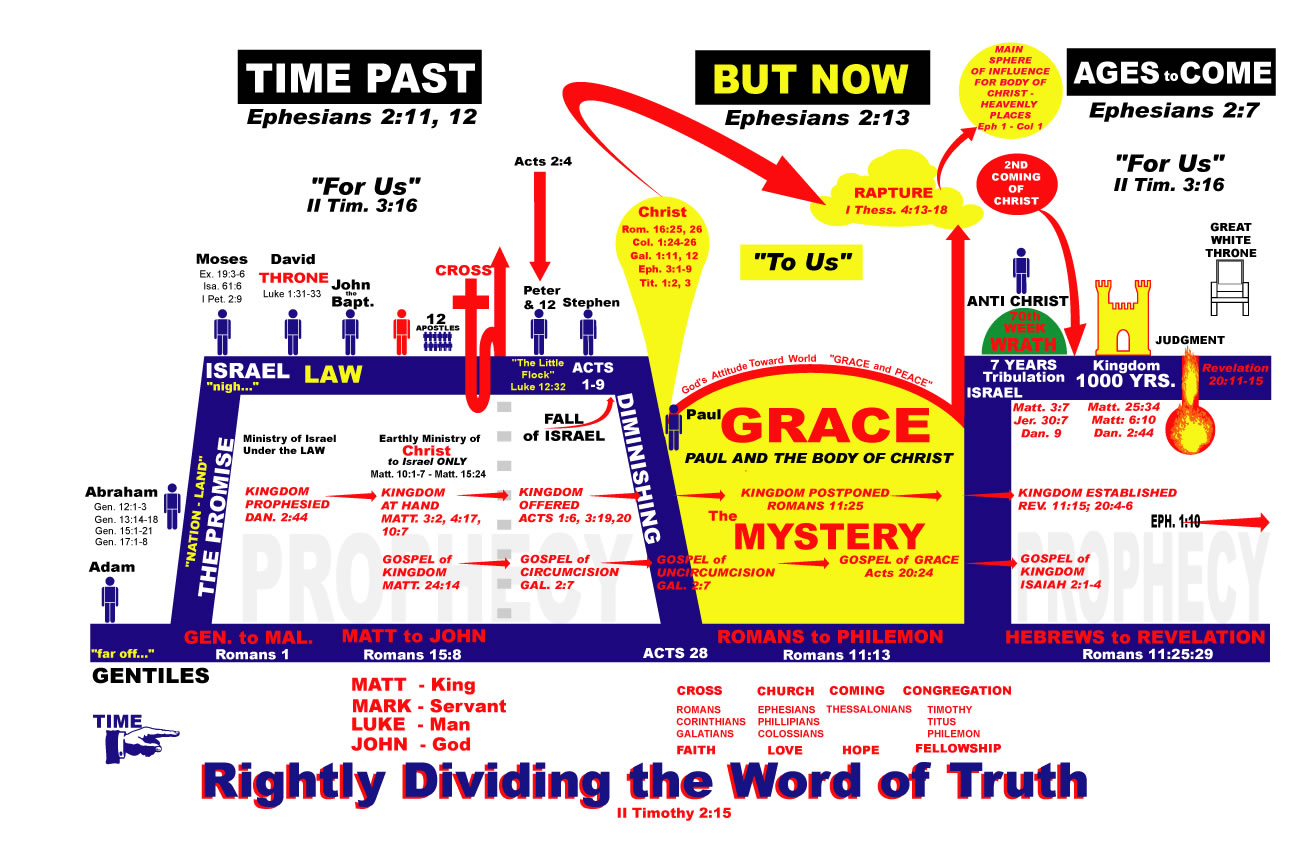
Classical Dispensation of the Law vs. Mid-Acts View
In the classical dispensation organizational view, the age of the Law finishes at the work on the Cross by the Lord Jesus Christ. I held this viewpoint during my initial years of Bible study, but have only recently gone back and updated this boundary.
The reason “why”, has to do with the way the text is presented throughout the early chapters of the book of Acts.
Brilliantly recorded by Luke, via inspiration of the Holy Spirit, the initial chapters of Acts deals with the Apostles that were in Jerusalem after the resurrection of the Lord Jesus Christ. After 40 days, Jesus Christ then ascends from the Mount of Olives back up to the throne room of God (Acts 1:9).
Still facing persecution, God had not given up on His people, and He was giving them a second chance to repent, turn to Him, and become the Holy Nation to the rest of the world. This would then result in the Second Coming of Jesus Christ within that generation to establish His millennial kingdom. In other words, for nearly the first half of Acts, Peter and the apostles are striving to continue the Kingdom program that Jesus Christ taught during His earthly ministry.
However, in His foreknowledge, God could see that Israel remained hard-hearted and would still refuse the Lord Jesus Christ.
In His infinite mercy and grace, God then introduced a complete disruption to His own timeline; the Dispensation of Grace - given to the once bloodthirsty, zealot Saul who became His chosen vessel to the Gentiles as Paul.
“For this cause I Paul, the prisoner of Jesus Christ for you Gentiles, if ye have heard of the dispensation of the grace of God which is given me to you-ward: how that by revelation he made known unto me the mystery; (as I wrote afore in few words, whereby, when ye read, ye may understand my knowledge in the mystery of Christ) which in other ages was not made known unto the sons of men, as it is now revealed unto his holy apostles and prophets by the Spirit; that the Gentiles should be fellowheirs, and of the same body, and partakers of his promise in Christ by the gospel:”(Ephesians 3:1-6)
There are a lot of things to pull apart and study in the Scriptures, and by God’s grace I will continue to post articles that will not only help to educate, but to bless and to trigger your own Bible study…
Don’t JUST take my word for it!
This article is meant to encourage and help you grow in your own walk, as I am always looking to grow in mine. I’m definitely not saying “I’M RIGHT! YOU WRONG!”, I’m just trying to communicate and record where my brain “organizes” a lot of things in the Bible.